Sunday, May 3, 2015

Inception

"Don't you want to take a leap of faith? Or become an old man, filled with regret, waiting to die alone..." (Saito, Inception)

Inception  is one of my all time favorite movies - it is not only one of the most interestingly developed in both literary and dramatic terms, but it also consists of brilliant cinematography. Directed by Christopher Nolan (my favorite director), and starring lead actor Leonardo DiCaprio (one of my favorite actors), this movie reigns as one of the best movies I have ever seen - and no, it isn't overrated. For this blog, I wanted to discuss some of the ideas that I was doing for my cinematic storyboard project. I wanted to get started on two specific shots, I feel, represent the essence of this movie. 


In this scene, Arthur (Joseph Gordon-Levitt), must provide a “kick” for his team in time but is required to fight with the dream’s defenses in order to complete his task. The director employs a wide shot to provide a view of the space around the body from a distance – this type of shot is integral in showing the peculiar nature of the rotating walls and changing environment of the dream. The director uses an eye-level camera angle to give the audience the impression of watching this scuffle within the action. By giving us an eye-level view, the audience is visually enamored by the character’s changing positions relative to the spinning maze-like environment. 
The camera moves on a boom crane in order to give the audience
full view of the action quickly and smoothly. As Arthur and his opponent jump and move from side to side, the camera follows the action with quick sweeps, similar to the way our eyes move when watching the shot. Basically, this scene is able to capture the very peculiar and unfamiliar sense of this movie - as well as portray some insanely well developed cinematic elements to a scene. 


In this long shot, Ariadne is creating a never ending image by making two mirrors reflect one another. I think the director chooses this type of shot to give the audience a full view of what the characters are seeing, and to draw attention to the fractured nature of Cobb’s reflection(s) in the shot – a very symbolic idea. In this scene, the director uses an eye-level camera angle, most prominently to make the audience feel as if we were standing there with Ariadne and Cobb. In this scene, the camera moves on a dolly, moving with the action, by moving around Cobb’s face and then onto the mirror scene. I think the swift and shaky camera movement is meant to mimic how Cobb feels in this situation – very curious but also very scared. The non-diegetic music in the background is interesting as it has two separate pieces of music going on at once – one is a slow dragging tune while the other is fast paced. These two tunes seem to represent the workings of Cobb and Ariadne’s minds. Where Ariadne is cool and calculated, Cobb is struggling to see what Ariadne is going to do next. I thought this shot was very interesting, as it not only showed us the fractured nature of our male lead, but also emphasized the relationship between two major characters. 

A true masterpiece, one must watch Inception to appreciate it for what is it - once you watch it, the idea will never go away! (See what I did there?)

"You mustn't be afraid to dream a little bigger, darling" (Eames, Inception


Sunday, April 19, 2015

The Theory of Everything

“There should be no boundaries to human endeavor. We are all different. However bad life may seem, there is always something you can do, and succeed at. While there's life, there is hope” (Stephen Hawking, The Theory of Everything). 

The Theory of Everything paints a brilliant portrait – it’s a film
that pays homage to a man who has revolutionized modern science. But more than that, this film is a love story, a film that intertwines the lives of Stephen Hawking, and his first wife Jane. Director James Marsh gives us a glimpse of a story that extends far beyond the confines an audience would expect, which fosters a unique personal connection between the audience and the couple. 

There are several cinematic elements at play throughout this film. As always, I love analyzing the beginning of a film as it is usually so integral to the development of the entire plot and theme. Interestingly, this film begins with a flash forwards, an element we are unaware of until the film progresses. The flash forward does have specific elements that characterize what is taking place. There is a significant difference in lighting and editing than what we would normally expect as “typical” or “normal.” The beginning of the film seems to have a tinted filter on it, coupled with an intentional decision to make the scene appear unfocused. Although we are unaware of what is happening, it is possible that the bright shades of light in this mysterious scene signify a happy environment. We are then warped back to what we would normally consider “typical” through a transformation in camera focusing and filter, as well as a change in diegetic sounds. The high-key lighting disappears and we are in neutral lighting accompanied by fast paced non-diegetic sound in the background – this sound seems to be important in signifying opportunity and adventure. 

The remainder of the film is focused around Hawking’s personal achievements – but furthermore, there is great emphasis on his relationship with Jane and their journey together. I would love to talk about the cinematic elements that characterized the two individual’s relationships. I noticed something very interesting – when Hawking is alone, the camera seems to focalize the camera and tell the story through his point of view – a subjective point of view. As the audience, we are presented with what he sees. There are several close-up shots of his face that reveal his look of intense concentration and interest in what he sees. The camera often zooms into his face and reveals the depth of understanding and curiosity within his eyes – which may often be the reason for the multiple cuts that occur simply to highlight Hawking’s fast moving eyes in the presence of his environment. He is in awe of his surroundings – always willing to learn more – and we become a part of his wonder. 

Something seems to change when Hawking and Jane are together. The camera no longer focuses everything we see on Hawking. The director makes a point to use vivid cuts and eyeline matches to emphasize the profound effect Jane’s attitude and charisma has on Hawking. We often see that the director makes it a point to use extreme close-up shots when signaling Hawking’s bodily changes in response to his developing motor-neuron disease. When these shots occur in the beginning, the audience is scared, frightened, and sad for Hawking. But by the end of the film, when we are back to the flash forward from the beginning of the film, the camera moves on a boom crane to show us the beautiful garden the couple are in. They are surrounded by beauty (emphasized by high key lighting), and surrounded by goodness. By this point, Hawking has lost his voice. He types to Jane, “Look what we made” – referring to their children. It is this moment that speaks out to us – the fact that there is beauty in his disease and state because he is surrounded by love. 

I really enjoyed this film – a great development that showcased the true meaning of love far beyond the typical movie we see today. The combination of camera shots, camera editing, camera movement, lighting, sound, and focalization were all integral components that combined to create the masterpiece that this Academy Award winner came to be.

“I want us to be together for as long as we have got. If that is not very long, well, then that is just how it is” (Jane Wilde, The Theory of Everything). 

Monday, March 30, 2015

Whiplash

“There are no two words in the English language more harmful than good job.” (Terence Fletcher, Whiplash)


Whiplash, directed by Damien Chazelle, is an Oscar nominated film about drummer Andrew Neiman (Miles Teller) who enrolls in at a cut throat music conservatory to be mentored by Terence Fletcher (J. K. Simmons) – a sadistic mentor who will stop at nothing to discover his students’ potential. The intriguing idea in this film – the idea that drew me towards it – is the complexity that underlies the simplicity of the plot. The plot is coupled with an extended parallel between the two main characters (mentor and student) as well as specific stylistic choices in cinematography that are integral in showcasing the theme and underlying meaning within this piece of work.

All the choices made in this film are done with significant reason. This is why I always find it so important to focus on the beginning of such a film, as it is often an indicator of what the remainder of the film will be. In this film, we are introduced to our main character, Andrew, in a narrow space presented through a long


shot, a hallway with low-key lighting that appears to be suffocating the viewer. The camera moves on a dolly and slowly zooms in towards the room in which Andrew is drumming in and the diegetic drum sounds are hard to escape. This appears to be a common theme, not only in the beginning of the film, but through the remainder of Andrew’s drumming experience. The room in which Andrew locks himself up in at night is small, dimly lit, and enclosed – instilling the sensation of being trapped and enclosed within an area. Similarly, the director chooses to introduce Andrew in this way to the audience so that we automatically signify this late night practice with Andrew’s dedication as well as his obsession with his ambitions of greatness.

The most important component of this film is the relationship between Andrew and Fletcher. The relationship is peculiarly captivating – it’s fascinating to see these two interact. We find that Andrew admires Fletcher albeit the abuse he must put himself through to gain Fletcher’s approval. Simultaneously, Fletcher has sensed something special in Andrew and relishes using every dreadful tactic he can to push Andrew to the very brink and test Andrew to the very last second. Cinematic elements play an enormous role in establishing this relationship, most prominently through camera shots and movement, editing, lighting, and sound.

Image result for whiplash fletcher  Image result for whiplash andrew crying

The most significant feature in the film is the use of close-ups to convey how each of the characters are feeling within particular situations. The most notable moments are seen through the various eyeline matches the director employs in order to let the audience understand how Fletcher and Andrew are feeling in response to the other. By using close-ups in these scenes, we ourselves experience the traumatic psychological and physical pain Andrew undergoes in his attempts to combat his own mentor. Furthermore, we cannot forget the furrowed brows and lingering glare that defines Fletcher’s ruthless attitude. By providing us with a series of eyeline matches and close-ups throughout the film (specifically when these two characters interact), we not only characterize the characters, but learn to connect with them as if we are sitting there in the same room.

Image result for whiplash andrew drummingLighting and sound are also significant to the development that occurs in the film. Oftentimes, when Andrew is practicing, there is very low-key lighting that is presented through bottom and side lighting. These sources of light often indicate morally unclear characters – a perfect description of Andrew, who struggles with choosing the correct strategy to gain what he desires. It is interesting to note that this same sort of lighting is often used with Fletcher as well, such as the final performance in which he purposely makes a fool of Andrew. Both characters are morally unclear and choose to execute some questionable decisions, but that is exactly what the director wants to relay to the audience. Both characters are here to achieve a unique and perfect level of musical excellence. Most prominently, sound is key to this film as the diegetic sound is vital in relating the mood of the film as well as the emotional states of the characters themselves. When Andrew is playing the piece in the beginning, the sounds resemble a drumroll, and we are waiting for the climax, for something to go wrong and for Fletcher to get angry again. When Andrew is angry and confused, it is often evident through his fast paced and almost chaotic drumming practice sessions.

My favorite part of this film was the ending – which was the moment at which I realized that this film was a true masterpiece. We finally see Andrew and Fletcher on the same stage – Fletcher conducting and Andrew stuck in a situation in which he must make a life-changing decision. When Andrew makes the decision to keep playing amidst the chaos, the director focalizes the camera to an authorial point of view in which he makes it a point to use extreme-close-ups on Andrew’s sweating face, his bleeding hands, and the sound of the drum that cut so sharply at our ears. 


In this moment we realize that Andrew and Fletcher are mere images of the other – Neiman seeks to find musical excellence with his percussive skills and tireless dedication, and Fletcher does so as a maniacal mentor who demands perfection. Through their shared stubbornness and unwavering desires to pursue their love of music and achievement – they realize (as significant through Fletcher’s final nod of approval to Andrew) that they are truly equals.

“I was there to push people beyond what's expected of them. I believe that's an absolute necessity.” (Terence Fletcher, Whiplash)

Sunday, March 8, 2015

Interstellar

“Mankind was born on Earth…it was never meant to die here.”


I’m always reluctant to watch films that are overhyped – I often find myself disappointed. But I suppose it’s hard to find yourself disappointed when you actually feel like a NASA explorer – one who has transcended space and time – by the time you finish a film. This week, I wanted to explore the beautiful cinematography of Interstellar, director by none other than Christopher Nolan (who has also directed movies like Inception and The Dark Knight for those of you who don’t know!). Nolan’s film explores the grand transcendence of space while selling the intimacy of the individual characters – making the film surprisingly relatable, and in other words, humane.

Interestingly, I also wrote about Interstellar for a paper in my Stellar and Galactic Astronomy class – so I consider myself quite the expert in the scientific phenomenon that Nolan chose to explore in this film. While reading about these, I found that the film successfully employs cinematic elements to help us understand the scientific aspects, as well as the literary and dramatic elements, of this film. If you’re ever going to tackle the issue of the fate of humanity, please make sure to call Nolan to assist you on that.

 I want to start with the discussion of both diegetic and non-diegetic sound in the film. The majority of this film takes place in space – a foreign and unfamiliar place to the majority of the audience. Interestingly, what I noticed right away was that camera shots shot outside the spaceship were accompanied by silence – we could not hear anything. There was no diegetic sound at all, and I believe this was done for multiple reasons. Sound in space only occurs in the form of electromagnetic vibrations that pulsate in similar wavelengths, sounds the human ear cannot perceive. Was Nolan only doing this to adhere to scientific accuracy? During these shots, I found myself holding my breath, waiting for something to happen – it was almost as if I was holding my breath in space myself. By stripping the shots from space of diegetic sound, Nolan communicates the emptiness, the vastness, and the mysteriousness of space. 

Furthermore, the actual musical score of this film is very interesting, because the diegetic sound tends to grow noticeably louder as the action in the film grows more exciting or intense. Typically, we associate a change in the pace of the music or simply the excitement factor of the music as a whole, but I noticed that the music always grew immensely louder when the intensity of action increased. An example of this is seen when Cooper is about to dock Endurance onto the rotating body in space. As a viewer, I think Nolan’s decision to use this type of music score is important in signaling to the viewer than something exciting is about to happen without distracting the viewer from the action at hand.

Throughout this film, I developed the feeling that Nolan was playing with two very different ideas: the grade nature of unexplored space and the fate of humanity versus the intimate nature of the relationship between Cooper and his team as well as Cooper and his family (specifically his daughter Murphy). Cinematic elements are critical in communicating these two very different ideas in the same movie.


Nolan often uses establishing shots as a means of setting the space of the scene – the spacecraft may not be very large but the outer environment is immensely vast. While the crew members inside the spacecraft are attempting to navigate through a tough area, or simply traveling through the emptiness of space, the camera often uses editing techniques in which it cuts to shots of the spacecraft in space and moves in dolly fashion to follow the action of the spacecraft. By cutting from shots inside the spacecraft to those outside the spacecraft Nolan successfully renews a sense of suspense and tension in the viewer – as outsiders we are afraid that something may go wrong. Furthermore, when the crew members are on different planets the camera focuses on the scenes in specific ways to stir specific feelings and responses. Oftentimes, camera framing techniques use long shots and wide shots to film the crew members on the planets.

The camera also shoots from extremely high angles, completely zoomed out, in which it looks down on the crew members. These two techniques successfully capture the surrounding scene of the individuals – planets that are vast, barren, and empty. This illustrates the relatively small nature of the individuals compared to the grand issue they are tackling – both literally and metaphorically. Furthermore, the barren land that surrounds the individuals instills a feeling of loneliness, isolation, and hopelessness in the audience. This is done intentionally, so that the audience is always hoping for some sort of big break.

As I mentioned earlier, Nolan also makes several key decisions in cinematography that aim to sell the individual moments of intimacy that help characterize this film. Most importantly is Cooper’s incessant need to finish the mission as soon as possible so that he may return to his family. The camera often captures Cooper’s almost aggressive nature by zooming in to his face in order to allow for close-ups that emphasize Cooper’s hardened face – he is serious when it comes to his family, and there is no time for playing around. One of the most touching scenes in the whole film is when he returns to the spacecraft from Planet Miller and finds that 23 years have passed since he first left, and he watches the radio messages that have been left from his family.

The camera makes it a point to gradually pan over onto Cooper’s face and zoom into his face, using a soft frontal lighting from the screen to emphasize his eyes (which have tears in them). This scene captures the intensity to which Cooper misses his family and the desperate feeling of longing that is left in him. Simultaneously, Nolan keeps the audience connected with Murphy (Cooper’s daughter) by cross cutting what is occurring in space with what is occurring on Earth – we see Earth subjectively, through Murphy’s point of view. By cross cutting between space and earth, Nolan reminds us that there is a connection that transcends Earth and space – love.

 The climax of the film occurs when Cooper is put into an alternate dimension – a visual representation of the dimension of time – the idea is both intriguing and revolutionary. But I don’t want to spoil the main idea of this film by discussing it – seriously watch this film!

“Do not go gentle into that good night; Old age should burn and rave at close of day. Rage, rage against the dying of the light.”

Sunday, February 22, 2015

The Breakfast Club

“You see us as you want to see us... in the simplest terms and the most convenient definitions. You see us as a brain, an athlete, a basket case, a princess, and a criminal. Correct? That's how we saw each other at seven o'clock this morning. We were brainwashed.”

This week, I’ve decided to take a break from code breaking and time crunches to explore John Hughes’ 1985 coming-to-age film The Breakfast Club. Needless to say, I finally understand the years and years of, “You haven’t seen The Breakfast Club?!” This film successfully blended elements of both comedy and drama while maintaining a level of depth and relativity that remains applicable to the typical youngster after all these years. Hughes’ ability to employ key cinematic and dramatic elements to further the characterization and relationships in the film is critical – taking teenage angst and transforming it into a timeless classic.

I always love analyzing the beginning of any film, as the opening of the film is often significant in relaying subtle hints that expose what the film plans to explore. The film begins with an almost ‘funky’ sound, if you will. Simple Minds’ stone classic “Don’t You (Forget About Me)” embodies the mid-eighties teenage generation, and stirs up a feeling of excitement and curiosity. More importantly, auditory elements are integral to the opening of the film as we hear Brian’s voice over narration speaking to the principal. He describes himself as a “brain” and goes on to describe the others around him as an “athlete,” a “basket case,” a “princess,” and a “criminal.” While he communicates ideas of stereotypes to the audience, visual elements are also at play. The camera features an establishing shot that runs through a series of shots, shown cut after cut, setting the scene of the whole film. The colors and vibrancy of yearbooks, stages, lockers, and classrooms kindle a sense of familiarity and amusement within the viewer. In one sweep, the film introduces (but really, reintroduces) the glory, fear, and craziness almost any individual can relate to. High school.

If I had to pinpoint the most important component of this film, I would definitely have to underscore the characterization and development in relationships that is so fundamental in understanding the deeper layers of this film. Every one of the five stereotypical characters are necessary in balancing out the others, and the interactions between the characters evidentially prove that. The film uses a variety of cinematic elements that help introduce the characters, and through these introductions we are later able to study the transformations the characters undergo.

So let’s discuss. Most prominent is John Bender (the “criminal”). Claire Standish (the “princess). Andy Clark (the “athlete”). Brian Johnson (the “brain”). And finally, Allison Reynolds (the “basket case”). As soon as the five teenagers are placed in the library together , we are able to connect them with the appropriate stereotype immediately because of how they are characterized. The camera angled at eye level, which not only gives us the ability to see everything that is occurring, but also helps us feels as if we are right there with the teenagers. We feel as if we are a part of the conversation. The director spends the majority of the film using both dramatic and cinematic elements to emphasize how perfectly these characters match their intended stereotypes.

Right away, we notice Bender, who fits the perfect “criminal” stereotype. His attempts to make the others feel uncomfortable characterize this stereotype, and the camera makes it a point to cut through close-ups of both Claire and Andy’s face in order to highlight the discomfort and anger they feel as a result of Bender’s rude humor. More interesting, the camera makes it a point to get multiple long shots of Bender in order to highlight the type of clothes and shoes he is wearing – the typical “bad boy” sort of look.

Claire’s pristine sense of self and need to be proper is characterized by her refusal to let Bender faze her – specifically when he is mocking her for how “pristine” she is. The camera engages in a series of eye-line matches to show reaction shots taking place in between Claire and Bender. When the camera cuts to Claire, there is a close-up to her face and we notice the discomfort she feels as her eyes keep straying away from Bender’s eyes. By noticing the way the camera moves around Claire, and her acting itself we are able to characterize her.

       For the majority of the film, Andy is the typical “athlete” we encounter in high school. He is ultimately defined by his Letterman jacket and his attempts to stand up to Bender’s attempts to make Claire uncomfortable. When Andy and Bender stand facing each other, we see medium shots of them, but the height difference is clearly noticeable (Bender is taller than Andy). Abruptly, Andy pulls a wrestling move on Bender and the camera tilts down and we see Andy in the dominant position. The camera movement shots and movements are critical in showing Andy’s internal need to use his athletic ability to show dominance over others.

Brian is the “brain” – the boy that is most usually supposed to be seen as a dorky, nerdy, blubbering genius that lacks all sense of social intelligence. The director does a fantastic job of emphasizing Brian’s stereotype by making sure there is no non-diegetic music (which often accompanies the background of other character’s conversation) when Brian speaks. This makes Brian’s stutter more obvious. Furthermore, the camera often cross-cuts over to Brian in order to illustrate his attempts to add a sense of logical input to many of the arguments that take place.

Allison is characterized as the “basket case” by her ill-fitting and dark colored clothes as well as her peculiar sense of humor. When Claire is explaining the difficulty she faces with her parents, the camera cuts over to a close-up shot of Allison’s face, as we hear her laugh for the first time. The camera also makes it a point to cross-cut over to Allison’s face when Andy claims that Bender “may as well not even exist at this school.” This cross cut emphasizes how well Allison relates to the same ideas Bender is being accused of.

It’s so important to notice how meticulously the camera framing, angling, and movement takes place in order to secure these stereotypes when we compare the teenagers after they smoke the marijuana and bond, specifically in the scene all five of them sit in a circle and admit their problems to one another. The camera moves itself on a track, in a circular fashion, in dolly motion. And soon, we become as immersed into the conversations as the individuals are themselves. There is a complete change sound with the introduction of a poignant non-diegetic tune in the background. As Andy admits his reason for being in detention the camera pans through the individuals and zooms into each of their faces. The director makes it a point to give each of the faces a soft front lighting to emphasize the tears in each of the teenagers’ eyes. These tears emphasized how each of them were not so different from the other – the idea that Claire may have her own moments of being a basket case, both Andy and Brian suffer because of pressure from their parents, and how Bender and Allison often feel secluded in their own ways. These moments define the moments in which each of the characters realizes that they are much more similar than they are different.


After this scene, when all five are done with their detentions, they walk out as new people, both literally and metaphorically. The song “Don’t You (Forget About Me) plays in the background and gives the lyrics a whole new meaning. All of them leave in such contrasting states in comparison to when they first arrived – most importantly is the use of natural light to emphasize the new found peace all five have found with their identities and with each other.

And we close with,

“You see us as you want to see us... In the simplest terms and the most convenient definitions. But what we found out is that each one of us is a brain…and an athlete…and a basket case… a princess…and a criminal.”

Sunday, February 8, 2015

The Imitation Game

“Are you paying attention? Good. If you're not listening carefully, you will miss things. Important things. I will not pause, I will not repeat myself, and you will not interrupt me.”


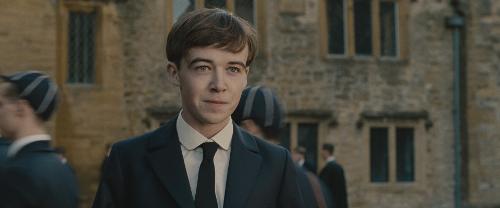
With lead actor Benedict Cumberbatch playing code-breaking mastermind Alan Turing, The Imitation Game is a touching tribute to an extraordinary man and his team. This film is, without a doubt, a rich piece that combines the suffering, heartbreak, and victory of war. The film is carefully crafted – as the literary development that takes place within the film is linked with a combination of both dramatic and cinematic elements. Blending these elements together allows the film to speak and break through to the audience on multiple levels.

The moment the film began, I was enraptured by the non-diegetic piano notes that planted a sensation of suspense and curiosity within me – before I even understood what was happening. Benedict Cumberbatch’s gravely deep voice provides us with voice-over narration through a series of cuts that pan over an amalgam of peculiar looking objects. At once, the film uses a combination of auditory elements and visual imagery to draw us into what is happening; I wanted to know what was going to happen next. The director’s choice of lighting and color throughout the introduction of the film is interesting; the shots take place with
low key lighting accompanied by neutral lighting shots sometimes (but even then, they are filtered to appear darker and more ominous). Color is rare, and surrounded by dull shades of blue, brown, grey, and black. This automatically told me that this film was not meant to be a happy victory; rather, that it would involve a complex plotline of mood changes and ethical dilemmas. Most noticeably, the introduction of the film was greatly representative of capturing the mood of the entire film: suspenseful, dramatic, dark, poignant.

There are so many aspects of this film that deserve recognition; it is hard to identify which few are worth mentioning in this review. So let me start with lead character Alan Turing (played by Benedict Cumberbatch) himself. What is it about his character that makes us root for him? How does the film make us empathize for an individual who begins by appearing so fixated on the logical that he forgets what is moral?  The director makes key decisions that are directly related to our relationship with Turing himself – we become a part of his story just as much, if not more, than Joan, Hugh, John, and Peter. This is primarily done through a series of flashbacks that take place throughout the film, instances in which we are able to access the areas of Turing’s mind that the others are unable to see.


Sometimes, these flashbacks are accompanied by Turing’s voice over narration, describing how he saw the world and what he learned from his observations. These flashbacks engage us through the simple use of camera angles, lighting, and sound. The flashbacks often feature a change in lighting and filter, indicating a time in which Turing had something he does not have now (we find that this ‘thing,’ is more a person (Christopher) as the film progresses). When Turing is trapped underneath the floorboards, he struggles for freedom in the dark (although there is some side lighting) and Christopher is able to remove the dark and literally and metaphorically bring light into his life. When young Turing reads Christopher’s letter, we view him from a low angle and full frontal lighting. These function to illustrate Turing’s newfound sense of empowerment and genuine happiness due to Christopher’s presence in his life. Thus, when we return from these flashbacks to his current state of life we cannot help but root for the socially awkward genius.

The film’s historical setting indicates that the Second World War is a huge part of defining the film. This is apparent through the multiple instances of cross-cutting that takes place between Alan’s personal interactions and those going on throughout the duration of the war. This cross-cutting serves to remind the audience that the war is still going, and that bloodshed is still occurring. But more importantly, this film focuses on Alan’s development through his relationships with people. This whole film is, in essence, Alan’s story (both literally and metaphorically). Alan’s most important human relationship is with Joan, played by Keira Knightly.
The bond is essential to the film.

This duo reminds us that love can form in the most unusual ways, even after everything has been taken away with you. Joan is the first character that Alan is enamored by, evident through the extra efforts made to get close-up shots of Alan’s face when he speaks to her. This is done primarily to emphasize how Alan is truly affected by Joan – she opens him up to his team (especially evident in the scene in which he brings them apples and attempts to tell a joke, had me laughing on the floor!). The film develops to show how Alan learns to becomes a family with his team, which was most clear the day that the individuals cracked ENIGMA. This scene focused on Turing amidst the action that was going on around him. The camera zoomed in on Alan’s face to show the vulnerability that was present – the emotional bond that we hadn’t been able to see before. This is underscored through the eye-line matches and reaction shots that take place between Turing and the other characters (specifically Hugh). This scene focalizes the scene into a subjective point of view – underscoring the idea that not only had Alan broken barriers by cracking the code, but he had also broken the barriers he had held up to separate himself from the rest of the world. The film does a great job of using cinematic elements to parallel both the plot’s development and Alan’s development.

Towards the end of the film, Turing undergoes a tragedy in which he is forced to take hormonal therapy in order to “cure” his “condition” (homosexuality). The ending is bittersweet, as Alan turns the light off after staring at ‘Christopher’ (the machine). His decision to turn the light off symbolizes that he no longer needs the machine, a mere tangible representation of Christopher, in his life because he has learned to accept and hold the best parts of Christopher within his heart. The most touching scene in this film is the last interaction between Alan and Joan, in which Joan tells Alan what he had told her when they first met: “Sometimes it’s the very people who no one imagines anything of who do the things no one can imagine.” A series of eye-line matches take place, and the camera focuses on casting light upon the tears that form on Alan’s face. 


This final exchange symbolizes the trickle of hope that remains in Turing’s life even after he feels completely lost. Although I later discovered that Alan Turing truly did end up committing suicide, I could not call it a tragedy.

We can call this film a lot of different things. A touching tale. A dramatic piece. A social commentary. Whatever it may be, I finish the film remembering the one quote that had me in tears by the end of the film:

“Sometimes it’s the very people who no one imagines anything of who do the things no one can imagine.”